
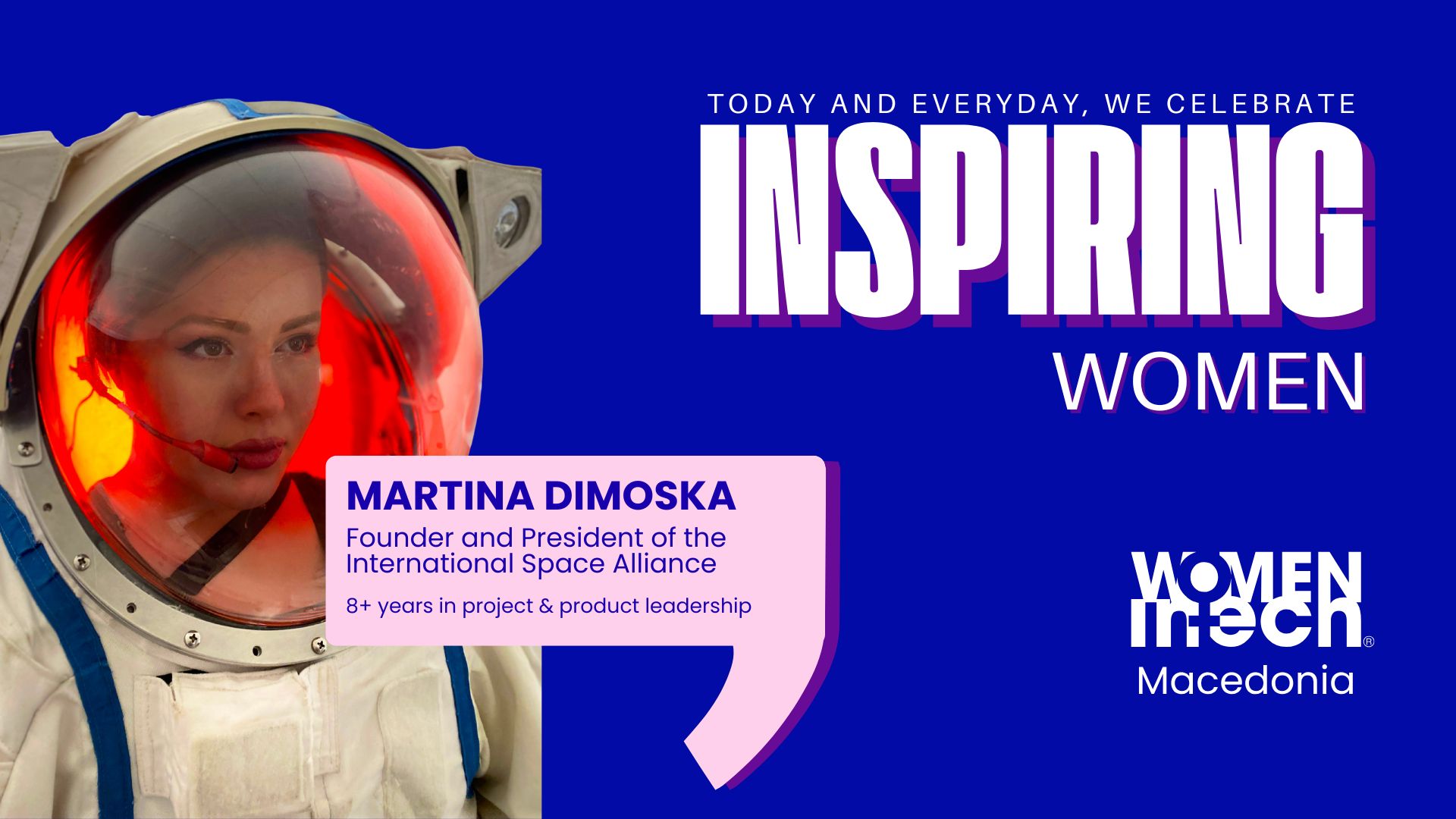
100 Interviews. One Month. One Global Mission.
This March, Women in Tech Macedonia launches 100 Interviews, a global storytelling initiative dedicated to amplifying the voices of women shaping technology across industries and borders.
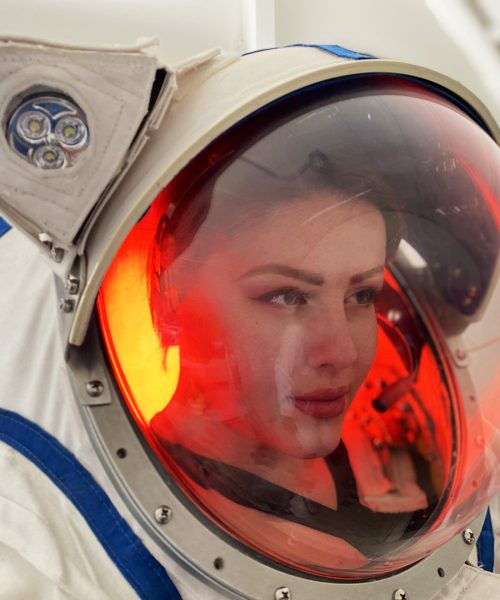
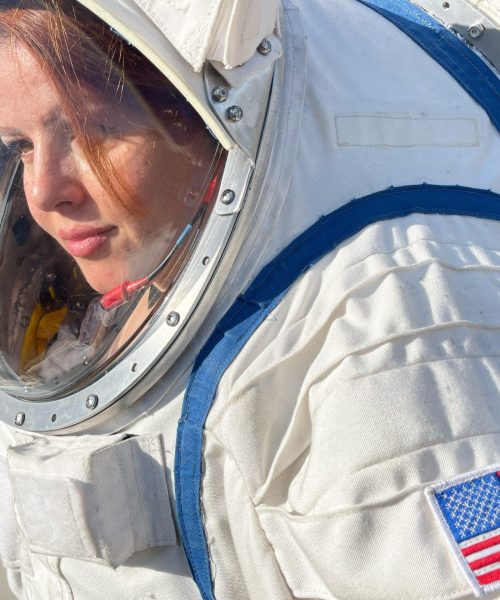
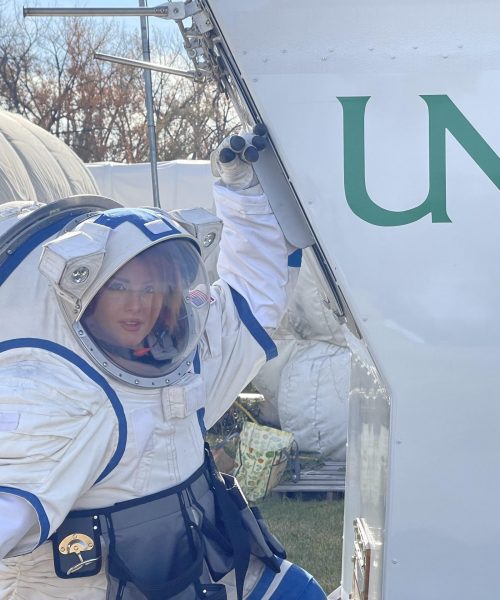
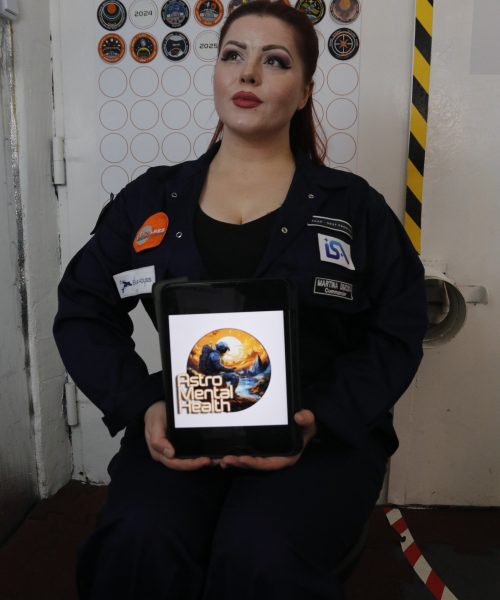
We continue this campaign with Martina Dimoska, Founder and President of the International Space Alliance and Consultant in Human Spaceflight at Blue Abyss. With over 8 years of experience and based in Silicon Valley, California. Martina works across space science, technology and international programs, building pathways where none previously existed.
Building Space Where None Existed
My “aha” moment didn’t happen in a classroom. It happened when I realized that waiting for permission from people who hadn’t walked the walk was keeping me out of rooms I was already qualified to enter. I was working across space science, technology, and international programs, often as the only woman, and the only person from my region, in the room. At some point, I stopped asking why there were no Macedonians in the space sector. The answer was obvious: it hadn’t been built yet. No one was going to make it happen for me or commit the time, energy, and sacrifice it demanded. By the time I realized that, I was already years deep in — and that someone happened to be me. That was the moment I understood that belonging in space tech isn’t about credentials alone, although they absolutely matter. Space education exists for a reason, and there is a real difference between trained professionals and those without that foundation. But beyond degrees, it’s about character, integrity, curiosity, competence, immense sacrifice, resilience, and the willingness to learn fast and build solutions where none exist.
I define success through impact — specifically, how many doors I open for others while building something meaningful. Titles and salary might matter to some, but they are not my metric. Success, to me, is measured by whether my work creates real opportunities, expands access to knowledge, and leaves behind systems that continue working even when I step away. If people can learn faster, dream bigger, or enter industries that once felt unreachable because of something I built — that’s success.

My non-negotiables are purpose-aligned work and healthy collaboration. I don’t work with people who drain energy, undermine trust, act with ill intent, or create unnecessary friction. In high-pressure fields like space and technology, character, boundaries, clear communication, trust, and transparency are essential. When one person fails, the entire mission is at risk — and as the saying goes, failure is not an option. Earlier in my career, in my youth, I was too generous with chances in the name of learning and novel experiences. But those experiences taught me to be deliberate and selective about who I surround myself with.
Accountability and alignment are not optional when lives, systems, and outcomes are on the line. There were years of constant overwhelm — not only from the work itself, but from the conditions surrounding it. I come from a country with virtually no space infrastructure or institutional support. While peers received scholarships, funding, and clear pathways from their national space agencies, I was living out of a suitcase, hopping between “breadcrumbs” of opportunity, chasing training, research access, and field experience wherever I could find them. I not only studied, trained, and conducted research, I was also working constantly just to cover basic necessities.
Belonging anywhere felt impossible. I couldn’t afford polished networking or visibility, and many missions were funded directly out of my own pocket because I believed the science mattered and the work had to exist, even when no system supported it. It became a constant loop of reinvestment with no safety net. If I got sick or lost momentum, everything was affected. I was spread impossibly thin, yet completely, obsessively committed to the dream. At the same time, I found myself in rooms where I was the youngest, the only woman, or the only person from my country working on space and technology programs. Imposter syndrome was definitely there, but I didn’t silence it with affirmations; I silenced it with preparation, training, and execution. I broke problems into concrete tasks, asked precise questions, learned relentlessly, and focused on delivering results. Confidence followed competence, not the other way around.
If I could leave a message, it would be this:
- Never ever ever give up.
- What if it doesn’t work out? Ah, but what if it does?
- Be so good they can’t ignore you.
- Luck is when readiness meets opportunity.
If I had to bet on one trend, do you even have to ask? Space exploration. Over the next five years, the convergence of space technologies with AI, advanced robotics, Earth observation, autonomous systems, human spaceflight, and in-situ resource utilization (ISRU) will reshape how we understand our planet, manage resources, and expand human presence beyond Earth. Space is no longer isolated — it impacts everyone and it is for everyone. It underpins climate monitoring, communications, security, scientific discovery, and global infrastructure. The next wave of impact will come from making space data actionable, scalable, and accessible across industries. Space exploration isn’t just about going farther; it’s about building the systems that sustain life, knowledge, and resilience here on Earth.
When it comes to productivity, I just sit down and do the work. Discipline matters more than motivation. I rely on health tracking and performance apps — staying healthy is non-negotiable for long-term performance. I often recommend The Diary of a CEO podcast, Veritasium, Johnny Harris, and Kurzgesagt. From books, definitely Life Beyond Us by the European Astrobiology Institute. That said, I mostly recommend research papers and industry-specific books — and when I’m unplugging, classics, fantasy, and sci-fi. When I’m not online, I’m at the gym, creating content, traveling, training, exploring, crafting, fixing and dismantling things, making, cooking, and planting.
To the girls in Macedonia, and everywhere else, I want you to know this:
Who convinced you you can’t reach for the stars? That path is closer than you think. Let’s reach for it together.