
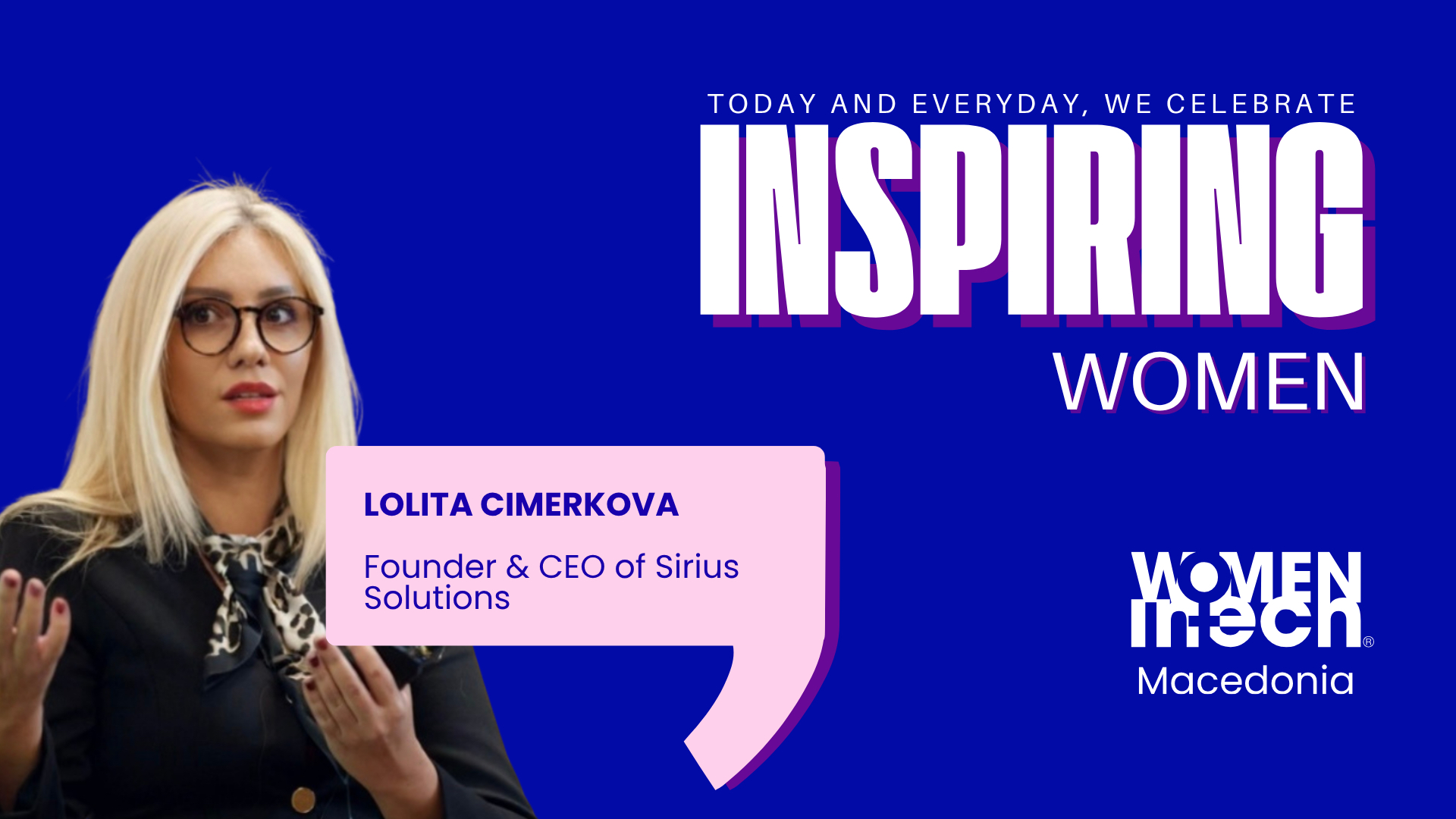
100 Interviews. One Month. One Global Mission.
This March, Women in Tech Macedonia launches 100 Interviews, a global storytelling initiative dedicated to amplifying the voices of women shaping technology across industries and borders.
Meet Lolita Cimerkova, Founder and CEO of Sirius Solutions, a business, marketing, and software solutions consultancy based in Skopje. With over 15 years of experience, Lolita has carved out a unique space in tech without writing a single line of code. Her approach is all about systems thinking, solving real problems for entrepreneurs and small businesses through CRM workflows, automation, and data-driven strategies that transform how companies operate.
When Systems Thinking Became My Superpower
My aha moment didn’t happen in a classroom or at a hackathon. It happened in the messy middle of real business problems.
I was working with entrepreneurs who were completely overwhelmed. They had customer data scattered everywhere, manual processes eating up their time, no visibility into their operations, and no structure for growth. These were capable people who were stuck. At first, I thought I’d just help them with marketing. But the more I talked to them, the more I realized marketing wasn’t the root issue. Their systems were.
So I started building solutions that went deeper. CRM workflows that actually made sense. Automations that gave them hours back in their day. Booking tools that stopped the endless email ping-pong. Data-driven strategies that helped them see patterns they’d been missing. I wasn’t coding from scratch, but I was architecting systems that changed how their businesses functioned.
The moment everything clicked was when I saw a small business owner finally gain clarity. She could see her customer journey. She saved hours every week on admin work. She started making decisions based on data instead of gut feelings. And she told me, with genuine relief in her voice, that she finally felt like she had control of her business again. That’s when I realized: this is tech. Not code alone, but systems thinking, problem-solving, and measurable impact.

For me, success has always been about impact. It’s not about the revenue number or how many clients I can sign. It’s about whether the technology I implement helps a business gain clarity, save time, and make better decisions. If a client can operate more efficiently and grow with confidence because of a digital solution we built together, that’s when I know I’ve succeeded.
But getting here meant pushing through some serious self-doubt. When I first started positioning myself in the tech space, I felt like a fraud. I wasn’t a developer. I didn’t have a computer science degree. I couldn’t talk about frameworks or backend architecture. There were moments when I’d be in a meeting, surrounded by people who could code circles around me, and I’d think: what am I even doing here?
The voice in my head kept saying I was unqualified. That I didn’t belong. That someone would eventually call me out.
I silenced that voice by focusing on outcomes instead of labels. My clients didn’t care if I could write Python. They cared that their business problems got solved. So I leaned into what I brought to the table: strategy, clear thinking, and real results. I let the work speak for itself. When a client’s operations run smoother, when they have time to focus on growth instead of firefighting, when they tell me their business has changed, that’s proof. Not code. Impact.


I’ve also had to set boundaries to stay grounded. Family time is non-negotiable for me. I have three kids, and when I’m with them, I’m fully with them. No phone, no Slack, no “just one quick email.” That boundary isn’t just about balance. It keeps me focused. And playing with my kids after a long day resets my brain better than any productivity hack.
Speaking of productivity, the one thing that works for me is time-blocking with clear priorities. I don’t plan my day around tasks. I plan it around outcomes. What needs to happen today for the business to move forward? What will make a real difference for a client? I block time for those outcomes, and everything else fits around them.
Looking ahead, if I had to bet on one trend, it would be AI-powered automation for small and micro businesses. Not AI as hype. I mean AI as a practical layer embedded in CRM, marketing, and operations. The kind that helps small businesses make faster decisions, automate repetitive processes, and scale without needing large teams. That’s where the real opportunity is.
To the girls in Macedonia, and everywhere else, I want you to know this:
Curiosity, discipline, and courage matter more than perfection. Start before you feel ready, ask questions boldly, and trust that your perspective is not a weakness. It’s your advantage.