
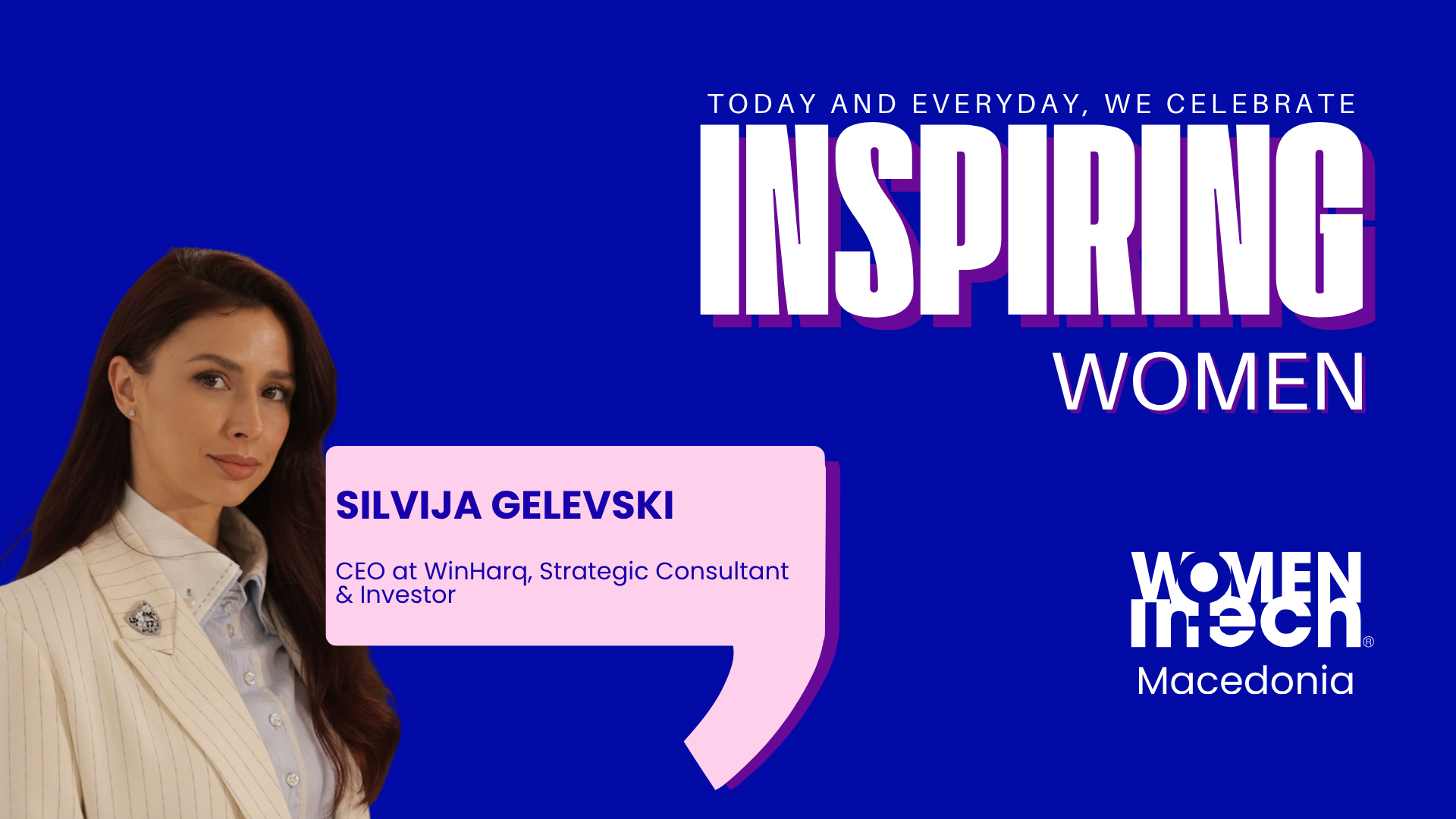
100 Interviews. One Month. One Global Mission.
This March, Women in Tech Macedonia launches 100 Interviews, a global storytelling initiative dedicated to amplifying the voices of women shaping technology across industries and borders.
We continue this campaign with Silvija Gelevski, CEO at WinHarq, Strategic Consultant and Investor. With 17 years of experience serving clients globally, she works at the intersection of technology, operations and business transformation.
From Dreamer to Builder
I never planned to be in tech. Since a young age, I planned to be tech. In 1997, I got my first computer and became obsessed. I spent years taking every course I could find, trying to get closer to a world I wanted to be part of. I enrolled in computer science, even when people around me questioned it. Then life changed overnight. My family went bankrupt. We lost almost everything. No electricity. No water. That moment forced a shift. I stopped being a dreamer and became a doer.
I started freelancing on oDesk, later found a full-time role, worked my way up to Global Operations Manager, studied on the side, and pushed through years of intense work. The moment I truly knew I belonged in tech came later, while managing operational chaos across teams and systems. I proposed building a centralized platform to fix it. The project was approved. I got a development team. That was my first real IT project. Watching something go from idea to a working product used by real people, that was the moment everything clicked.
From there, I went all in. I built a career in project and program management, moved into leadership and eventually into executive roles. Somewhere along the way, I found my real space, the intersection of technology and business. Where systems, structure and decisions scale into something meaningful. The dream never changed. The path just became bigger.
For me, success is not titles or salary. The real metric is impact that outlasts my involvement. Whether it’s organizations that operate better without me, leaders who continue teaching others, or systems still running years later, that’s how I measure success.
The question is always the same: did I leave this better than I found it?

My non-negotiable is mornings with my family. Before the world demands anything, there is time that belongs only to them. I wake up early, make breakfast, and protect that routine no matter how busy life gets. It’s not about big gestures, but small, consistent ones. That’s what everything else stands on. Success without presence is just performance.
One of the strongest imposter moments I experienced was walking into a boardroom as the decision-maker, the only woman at the table. At first, I thought I needed to work harder, prepare more, overdeliver. But what changed everything was understanding that imposter syndrome is not proof you don’t belong, it’s your nervous system reacting to something unfamiliar. I learned to separate emotion from fact. The feeling might say you don’t belong, but the facts, your results, experience, and track record say otherwise. The voice doesn’t disappear. You just stop giving it authority.
If I could leave one message, it would be this: nobody is you and that is your superpower. Your experiences, your perspective, your path, there is no template for that. Don’t waste time trying to fit into one.
Looking ahead, I would bet on operational AI. Not AI as a feature, but AI embedded into how businesses actually run. The difference will be between companies that build strong operational foundations and those that automate chaos. AI will not fix broken systems. It will expose them faster. The future belongs to those who understand how to combine AI, processes and organizational structure into something that actually works.
My productivity system is ruthless time-blocking. If it’s not on the calendar, it doesn’t exist. I treat my calendar as a declaration of what matters, not a record of what happened.
The app I rely on most is Sleep Mode on my phone, protecting focus is a strategy. A podcast I recommend is My First Million.
When I’m not online, I’m at the gym, cooking with my kids, or spending time with close family and friends.
To the girls in Macedonia, and everywhere else, I want you to know this:
You don’t need perfect conditions. You need a laptop, internet, and the decision to start.
You are not too early, too far, or too unlikely. You are exactly enough.
Now go build something.